Healthcare IT Support
01Day-to-day technical support for clinical and administrative staff: endpoint troubleshooting, EHR access issues, network incidents, and on-call escalation paths built around clinical hours, not standard business hours.
We provide managed IT services for healthcare, custom software development, and cybersecurity support for clinics, hospital networks, and health-tech companies — built to hold up under HIPAA obligations, uptime requirements, and the pace of a care environment that can't afford downtime.
Healthcare IT is two connected disciplines that are often sold as one and delivered as neither. Managed IT services for healthcare keep the day-to-day infrastructure — networks, endpoints, EHR access, help desk tickets — running reliably and securely. Healthcare software development builds the applications on top of that infrastructure: patient portals, workflow automation tools, CRMs, and clinical or administrative platforms.Both disciplines carry the same underlying constraint: HIPAA and HITECH compliance is not optional, downtime has a direct clinical cost, and every system eventually needs to talk to an EHR. We scope, build, and support both sides — IT operations and custom development — under the same compliance and architecture standards.
Healthcare organizations operate under stricter data and availability obligations than almost any other software category — a single misconfigured endpoint or unpatched system is a compliance incident, not just an IT ticket.
| Area | Focus |
|---|---|
| Patient Data Protection | HIPAA, HITECH, PHI encryption at rest & in transit |
| Interoperability Standards | HL7, FHIR, EHR/EMR integration |
| Cybersecurity | Threat monitoring, endpoint protection, incident response |
| Infrastructure Compliance | Access controls, audit logging, backup & disaster recovery |
Our healthcare cybersecurity services cover continuous endpoint monitoring, patch management, access control audits, and incident response planning — the same standard we apply whether we're managing your network or building a patient-facing application on top of it. Business Associate Agreements, audit logging, and encrypted backups are standard scope, not a paid add-on.
HIPAA-aligned, continuously monitored environmentWe run a six-stage process across both managed IT engagements and software builds. Each stage has a defined output and a sign-off gate — nothing moves forward until the previous stage is confirmed.
infrastructure and endpoint inventory, EHR/EMR integration mapping, compliance gap assessment, stakeholder workshops
network/security architecture or application UX design depending on scope, interoperability planning, risk register
two-week sprints for development work; staged rollout for IT infrastructure changes, with rollback plans at every step
functional and performance testing, penetration testing, HIPAA compliance validation, load testing
staged go-live, staff training and documentation, 30-day hypercare support window
ongoing help desk support, monthly security and performance reviews, quarterly roadmap updates
Healthcare organizations rarely need just one of these — most engagements start with one service and expand once the infrastructure or application layer proves out. We scope each one individually rather than selling a fixed bundle.
Day-to-day technical support for clinical and administrative staff: endpoint troubleshooting, EHR access issues, network incidents, and on-call escalation paths built around clinical hours, not standard business hours.
Ongoing management of networks, servers, endpoints, and backups under a defined SLA, with proactive monitoring rather than reactive ticket handling. Built to reduce the operational load on internal staff who aren't IT specialists.
Migration, configuration, and ongoing management of cloud infrastructure (AWS, Azure, GCP) for EHR hosting, backup/disaster recovery, and application workloads, with cost and compliance monitoring built in.
Threat monitoring, vulnerability assessments, endpoint protection, and incident response planning, scoped against HIPAA Security Rule requirements rather than generic enterprise security checklists.
Custom ticketing and support-desk platforms for internal IT teams or patient-facing support lines, with role-based routing, SLA tracking, and integration into existing IT service management tools.
Automating manual administrative processes — intake forms, scheduling, referrals, prior authorizations, billing workflows — to reduce staff time spent on repetitive tasks and cut down on manual data-entry errors.
Patient portals, provider-facing dashboards, and public-facing healthcare websites built for accessibility (WCAG), HIPAA-compliant form handling, and integration with scheduling and EHR systems.
Multi-tenant healthcare platforms — practice management tools, remote monitoring products, telehealth platforms — built for scale, with tenant-level data isolation and compliance built into the architecture from day one.
AI-driven patient intake, symptom triage, and appointment-scheduling assistants, built with clear escalation paths to human staff and without storing PHI outside compliant infrastructure.
Custom CRM systems for patient relationship management, referral tracking, and care coordination — built where off-the-shelf CRMs don't fit clinical workflows or compliance requirements.
Dedicated QA for healthcare applications: functional testing, HIPAA compliance validation, interoperability testing against HL7/FHIR standards, and security testing before and after every release.
Healthcare systems are judged on uptime and interoperability first, features second. Architecture decisions made early determine whether a platform can pass a compliance audit and connect to a hospital's EHR without a custom one-off integration for every client.
HL7 and FHIR-based integration engines connect custom applications to existing EHR/EMR systems (Epic, Cerner, Athenahealth), so new tools extend the existing clinical record rather than creating a parallel, disconnected data source.
Role-based access control, multi-factor authentication, and audit logging are implemented at the infrastructure level, so every access to patient data is authenticated, scoped, and logged by default.
Backup and disaster recovery are designed against clinical uptime requirements, not standard business-continuity targets. Redundant infrastructure and tested failover processes are scoped in from the start, not added after an incident.
| Layer | Components | Technology Examples |
|---|---|---|
| Presentation | Patient portal, provider dashboard, admin panel | React, Next.js, React Native |
| API Gateway | Auth, routing, rate limiting | Kong, AWS API Gateway |
| Application | Workflow logic, scheduling, CRM, chatbot engine | Node.js, Python, Go |
| Interoperability | EHR/EMR integration, data exchange | HL7v2, FHIR, Redox, Mirth Connect |
| Data | Patient records, application data, audit logs | PostgreSQL, encrypted S3, audit-log stores |
| Infrastructure | Monitoring, backup, disaster recovery | AWS/Azure, Datadog, automated backup pipelines |
| Capability Area | Core Capabilities | Advanced Capabilities |
|---|---|---|
| IT Support | Endpoint troubleshooting, ticketing | Proactive monitoring, on-call escalation SLAs |
| Cloud Infrastructure | Hosting, backup | Auto-scaling, cost & compliance monitoring |
| Cybersecurity | Endpoint protection, patching | Threat monitoring, incident response planning |
| Workflow Automation | Digital forms, basic scheduling | Multi-step referral/authorization automation |
| CRM & Patient Engagement | Contact and referral tracking | Care coordination workflows, automated follow-up |
| Chatbots | Basic FAQ and scheduling bots | AI triage with escalation to clinical staff |
| Testing & QA | Functional and regression testing | HIPAA compliance validation, HL7/FHIR interoperability testing |
Coralsoft works across both sides of healthcare technology — infrastructure and custom development — rather than treating one as a lead-in to sell the other.
HIPAA, HITECH, and audit-logging requirements are built into scoping from the first conversation, not addressed in a separate compliance phase after development starts.
Whether we're managing your network or building a patient-facing application, both run against the same security, uptime, and documentation standards — so nothing falls into a gap between an IT vendor and a dev shop.
We design new applications to extend existing EHR/EMR systems through HL7 and FHIR, rather than creating disconnected tools that add manual work for clinical staff.
Healthcare IT support and help desk services are structured around the reality that clinical operations don't stop at 5pm, with escalation paths and SLAs built accordingly.
Production-grade products. Real users. Measurable outcomes.
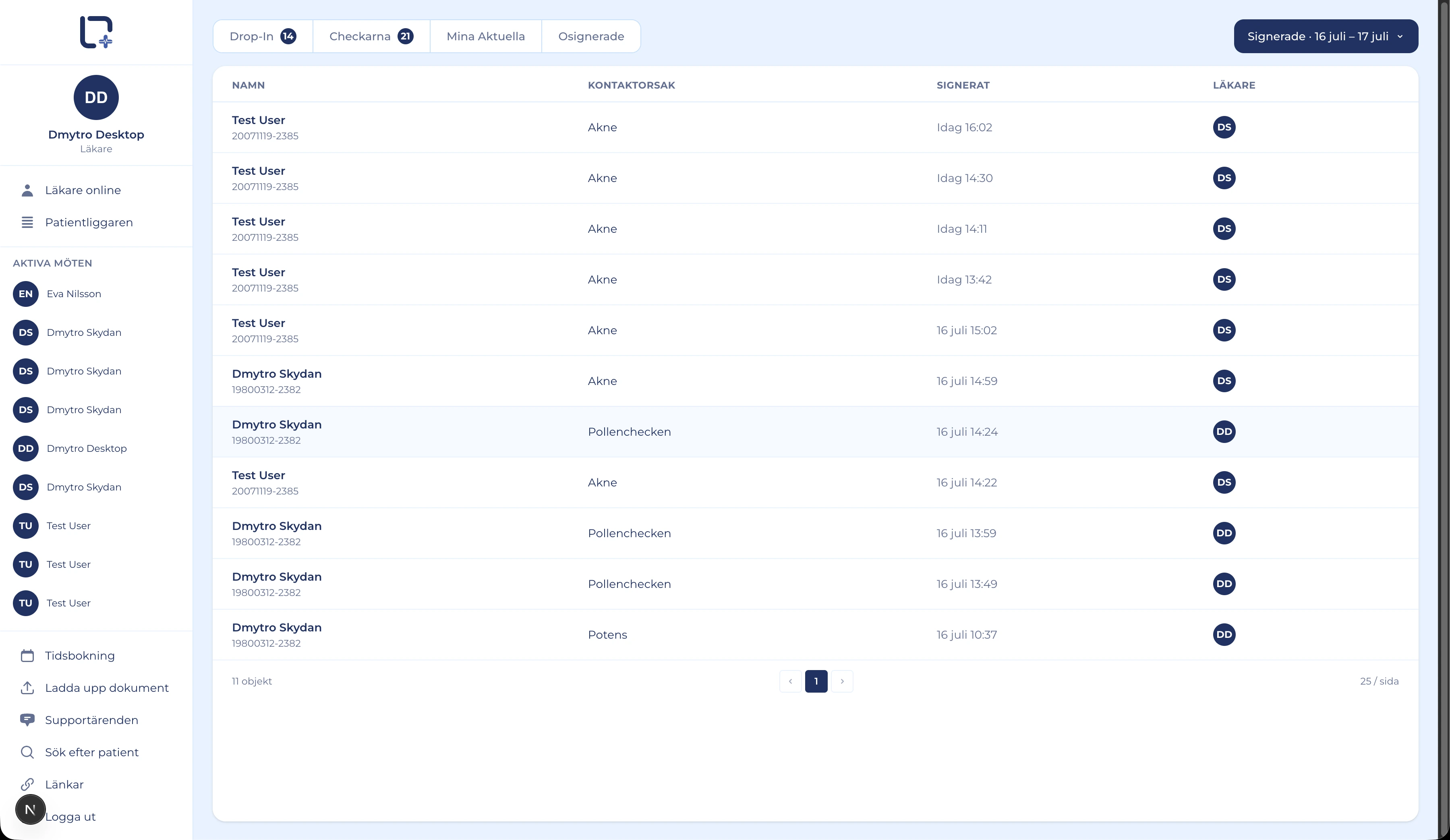
Läkare is a Swedish telemedicine platform connecting patients with doctors for remote care — drop-in consultations, prescription renewals, medical certificates, and specialist referrals — rebuilt full-stack from a Spring Boot monolith onto Bun, Hono, oRPC, Drizzle, and PostgreSQL, with a from-scratch BankID implementation and an idempotent Webdoc EHR integration.
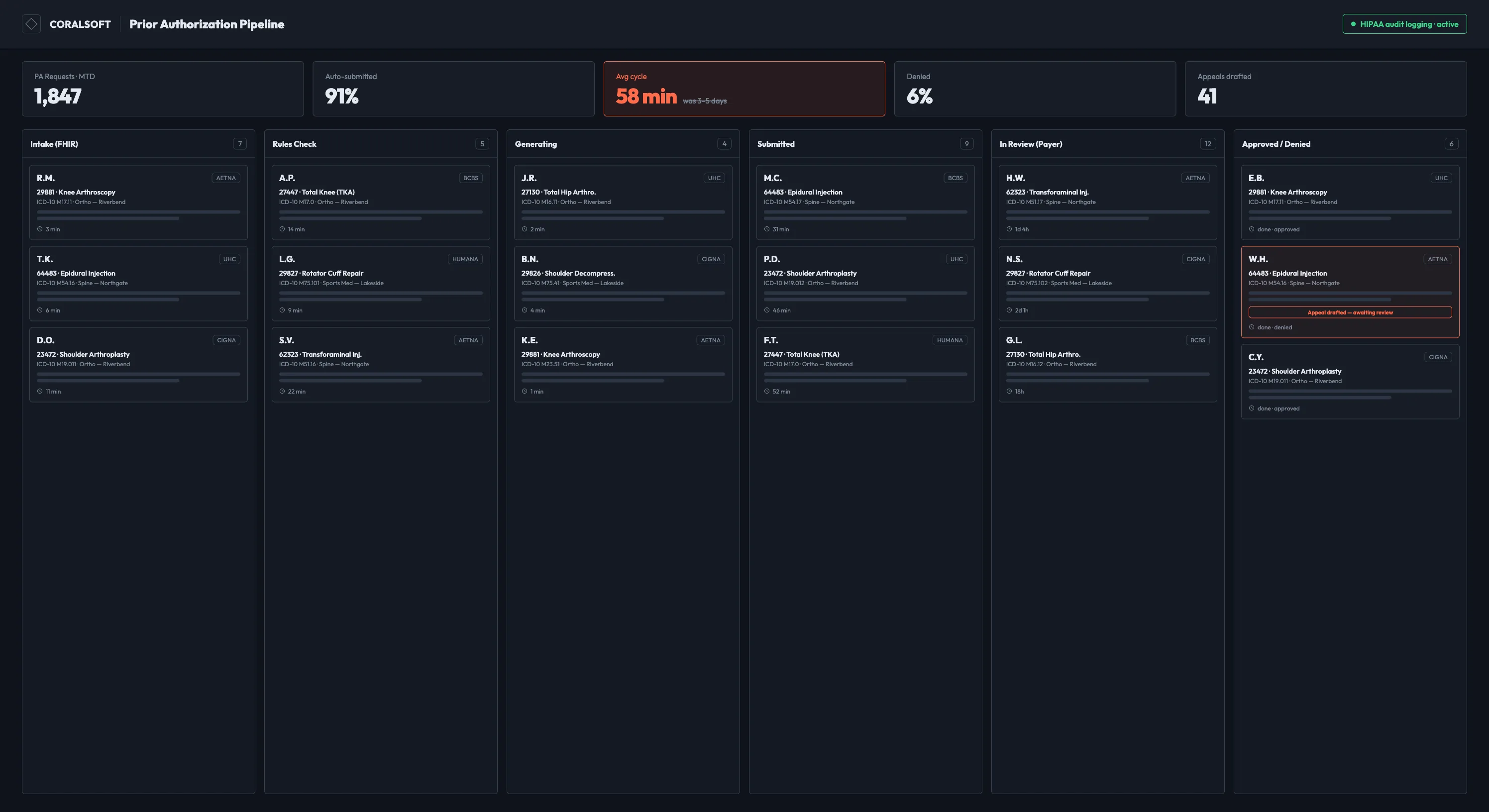
An autonomous AI agent — acting inside payer portals, generating documents, and tracking statuses, not a chatbot — that runs the full HIPAA-compliant prior authorization cycle for a medical billing company serving 22 outpatient clinics.
We match the commercial structure to whether you need ongoing IT operations, a scoped build, or flexible development capacity.
Ongoing management of infrastructure, security, and help desk operations under a defined SLA. Ideal for clinics and healthcare organizations without a full internal IT team.
Scoped deliverable, fixed budget, guaranteed timeline for a defined software build — a patient portal, a CRM, a workflow automation tool — where budget approval requires certainty.
Pay for hours of actual engineering or IT work. Best suited to evolving projects, security remediation work, or ongoing development capacity where scope shifts as priorities change.
Answers to the questions we hear most before kick-off.
Tell us your use case — infrastructure, a software build, or both. We'll map the right architecture, identify compliance and integration dependencies, and give you a realistic cost estimate — in one 30-minute call. No obligation.