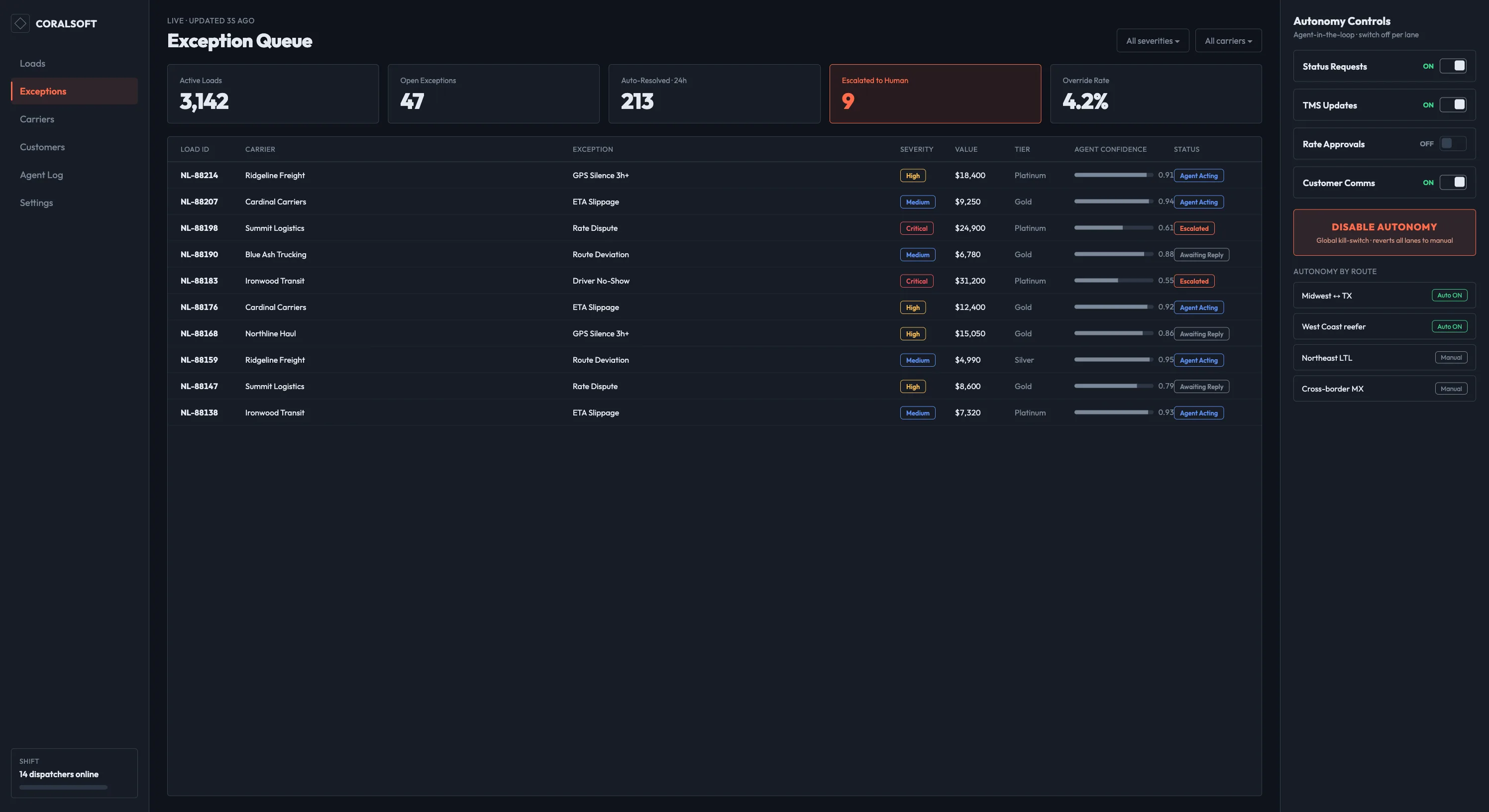
Transportation Management Systems (TMS)
01Core platforms for planning, executing, and tracking freight movement across carriers and modes, with rate management, load tenders, and carrier performance tracking built in.
We provide logistics software development services and transportation software development services for carriers, freight brokers, 3PLs, and supply chain companies — built around real-time visibility, not static reporting after the fact.
Logistics software development is a discipline built around real-time, multi-party data — a shipment's status has to be visible to a shipper, a carrier, a dispatcher, and a customer at the same time, often across different systems that were never designed to talk to each other. Transportation software development extends that further into fleet telematics, routing, and driver-facing tools operating in the field, not just at a desk.A logistics software solution that works on paper often breaks down at the integration layer — EDI feeds, telematics data, customs documentation, and carrier APIs that all use different formats and different update frequencies. We scope every transportation and logistics software development company engagement around that integration surface first.
Logistics and transportation software carries regulatory and safety obligations that vary by mode of transport, region, and whether the platform touches cross-border shipments.
| Area | Focus |
|---|---|
| Driver & Fleet Compliance | ELD mandates, Hours-of-Service (HOS) tracking |
| Trade & Customs | Cross-border documentation, customs data handling |
| Data Security | Multi-party data sharing, carrier/shipper access control |
| Cargo & Liability | Chain-of-custody tracking, proof-of-delivery records |
A logistics management software development company has to design for the fact that shippers, carriers, and end customers all need visibility into the same shipment — but not into each other's rate data or contract terms. We build role-based access control and audit trails into the data layer from the start, so a platform that adds a new carrier or partner doesn't require a redesign of who can see what.
compliant, multi-party visibility platformWe run a six-stage delivery process across logistics and transportation software development services engagements, whether the product is a TMS, a fleet platform, or a freight marketplace. Each stage has a defined output and a sign-off gate.
stakeholder workshops, carrier/telematics/EDI integration inventory, compliance requirements, workflow mapping across dispatch, drivers, and customers
information architecture, dispatch and tracking flow design, wireframes, prototype validation
two-week sprints, sprint review demos, parallel backend/frontend/mobile development
functional and performance testing, integration testing against live carrier/telematics feeds, security testing, load testing under peak shipment volume
staged rollout with feature flags, dispatcher and driver documentation, 30-day hypercare support
monthly analytics reviews, route and dispatch efficiency tuning, quarterly roadmap update
Logistics is not one product category — a logistic software solution built for a freight broker looks nothing like one built for a last-mile delivery company, even though both involve moving things from one place to another.
Core platforms for planning, executing, and tracking freight movement across carriers and modes, with rate management, load tenders, and carrier performance tracking built in.
Real-time vehicle tracking, driver behaviour monitoring, maintenance scheduling, and fuel-efficiency analytics, integrated with ELD and telematics hardware.
Inventory tracking, pick-and-pack workflows, and warehouse slotting optimisation, integrated with TMS and order-management systems to keep inventory and shipment data in sync.
Two-sided platforms connecting shippers with available carrier capacity, with automated rate matching, load booking, and carrier vetting built in.
Driver-facing apps with dynamic route optimisation, proof-of-delivery capture, and real-time customer tracking links for the final, most visible leg of a shipment's journey.
End-to-end dashboards aggregating data from multiple carriers, warehouses, and systems into a single view — the layer that turns fragmented tracking data into a coherent supply chain picture.
A production logistics platform is judged on real-time accuracy first — a tracking dashboard showing stale location data is worse than no dashboard at all. Architecture decisions made early determine whether the platform can absorb a new carrier integration or a telematics hardware change without a rebuild.
EDI feeds, telematics data, and carrier APIs arrive in different formats and on different schedules. A normalisation layer converts everything into a single internal schema before it reaches dispatch tools or customer-facing tracking.
Shipment status updates, GPS pings, and exception events (delays, route deviations) are processed through an event-driven architecture, so every party sees a status change within seconds, not on the next batch sync.
We deploy on AWS, GCP, or Azure using containerised microservices (Docker/Kubernetes), with high-frequency location data separated from transactional data (rates, contracts, invoices) to keep both performant at scale.
| Layer | Components | Technology Examples |
|---|---|---|
| Presentation | Web app, mobile driver app, dispatcher dashboard | React, Next.js, React Native |
| API Gateway | Auth, routing, rate limiting | Kong, AWS API Gateway |
| Application | Dispatch logic, routing engine, load matching | Node.js, Python, Go |
| Integration Layer | EDI, telematics, carrier APIs | EDI X12, Samsara, Project44 |
| Real-Time Events | Location updates, status/exception events | Kafka, MQTT, WebSockets |
| Data | Shipment records, fleet data, analytics | PostgreSQL, TimescaleDB, S3 |
| Infrastructure | Auto-scaling, CI/CD, monitoring | AWS EKS, GitHub Actions, Datadog |
| Feature Category | Core Capabilities | Advanced Capabilities |
|---|---|---|
| Tracking & Visibility | Shipment status, basic GPS tracking | Real-time multi-party tracking, exception alerts |
| Dispatch & Routing | Manual load assignment | Automated dispatch, dynamic route optimisation |
| Fleet Management | Vehicle list, maintenance logs | ELD integration, driver behaviour scoring |
| Warehouse Operations | Inventory counts | Pick-path optimisation, slotting automation |
| Carrier & Freight Matching | Manual rate lookup | Automated rate matching, carrier vetting |
| Compliance | Basic HOS logging | Automated compliance reporting, audit trails |
| Reporting | Standard shipment reports | Predictive delay analytics, cost-per-mile dashboards |
Coralsoft treats logistics and transportation as a discipline shaped by integration complexity and real-time accuracy, not a standard business-app build.
We've worked with EDI feeds, telematics hardware, and carrier APIs that don't share a common format — the layer that determines whether a logistics management software development company's platform actually reflects reality or just what was last synced.
Event-driven data pipelines are built in from the start, so status updates, exceptions, and location data reach every party without a batch-processing delay.
Role-based visibility across shippers, carriers, dispatchers, and customers is designed into the data model, not patched in when a new partner type gets added.
From integration scoping to post-launch route and dispatch optimisation, we run the complete lifecycle of a transportation and logistics software development company engagement.
Production-grade products. Real users. Measurable outcomes.
We match the commercial structure to your funding stage, delivery risk, and internal capability.
A senior engineer, logistics product specialist, and UX designer embedded in your product cycle. Ideal for funded logistics startups and established carriers or 3PLs building long-term platforms.
Scoped deliverable, fixed budget, guaranteed timeline. Best suited to well-defined MVP builds — a TMS module, a tracking dashboard — where budget approval requires certainty.
Pay for hours of actual engineering. Maximum flexibility for evolving product briefs or integration-heavy builds where carrier or telematics availability shapes scope as you go.
Answers to the questions we hear most before kick-off.
Tell us your use case. We'll map the right architecture, identify integration dependencies, and give you a realistic cost estimate — in one 30-minute call. No obligation.